Never feel unsure about a lab report again.
Spot the value, understand what it means, take the next step — in 90 seconds. When to treat, when to repeat, when to refer — a clear answer for every report.
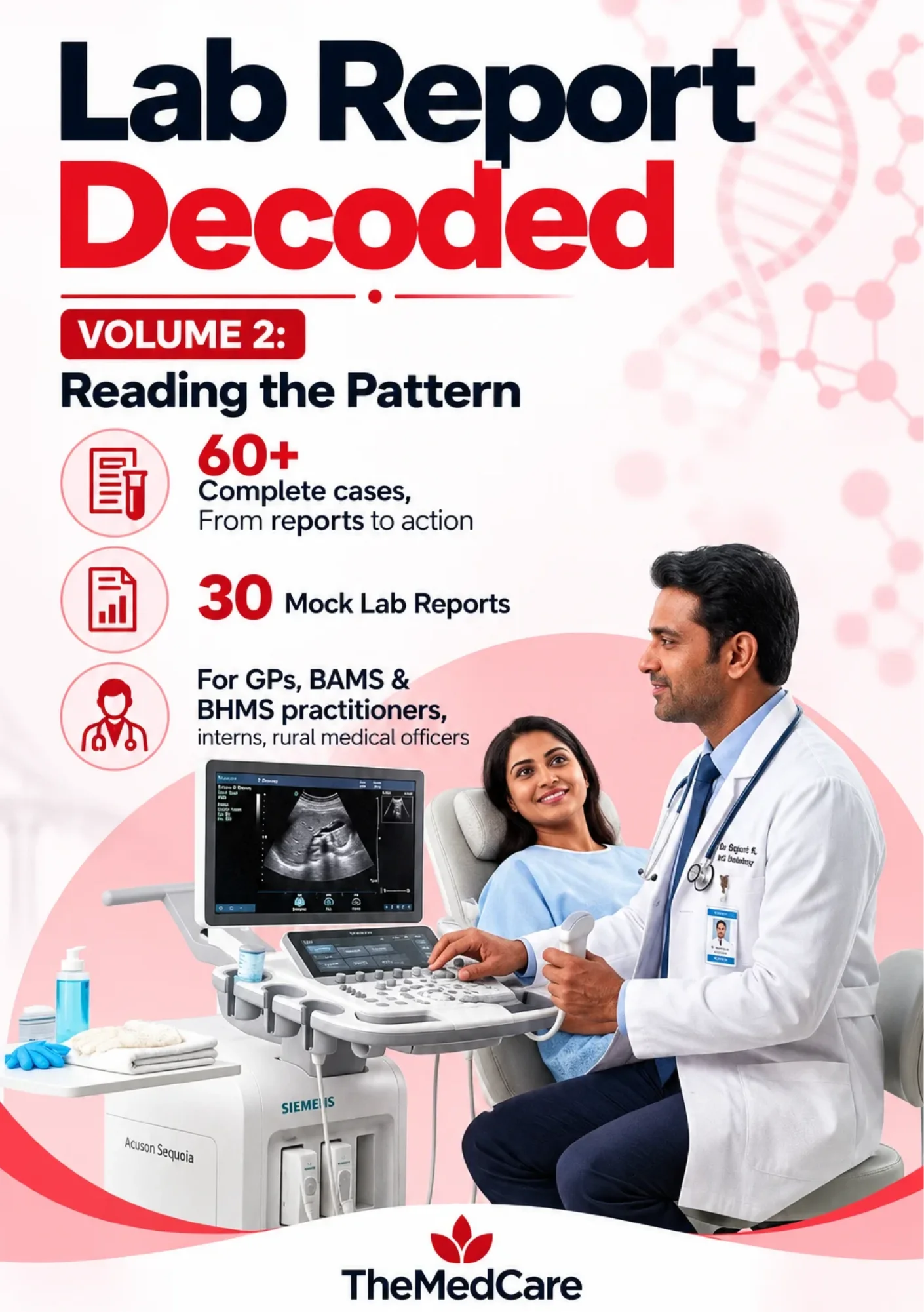
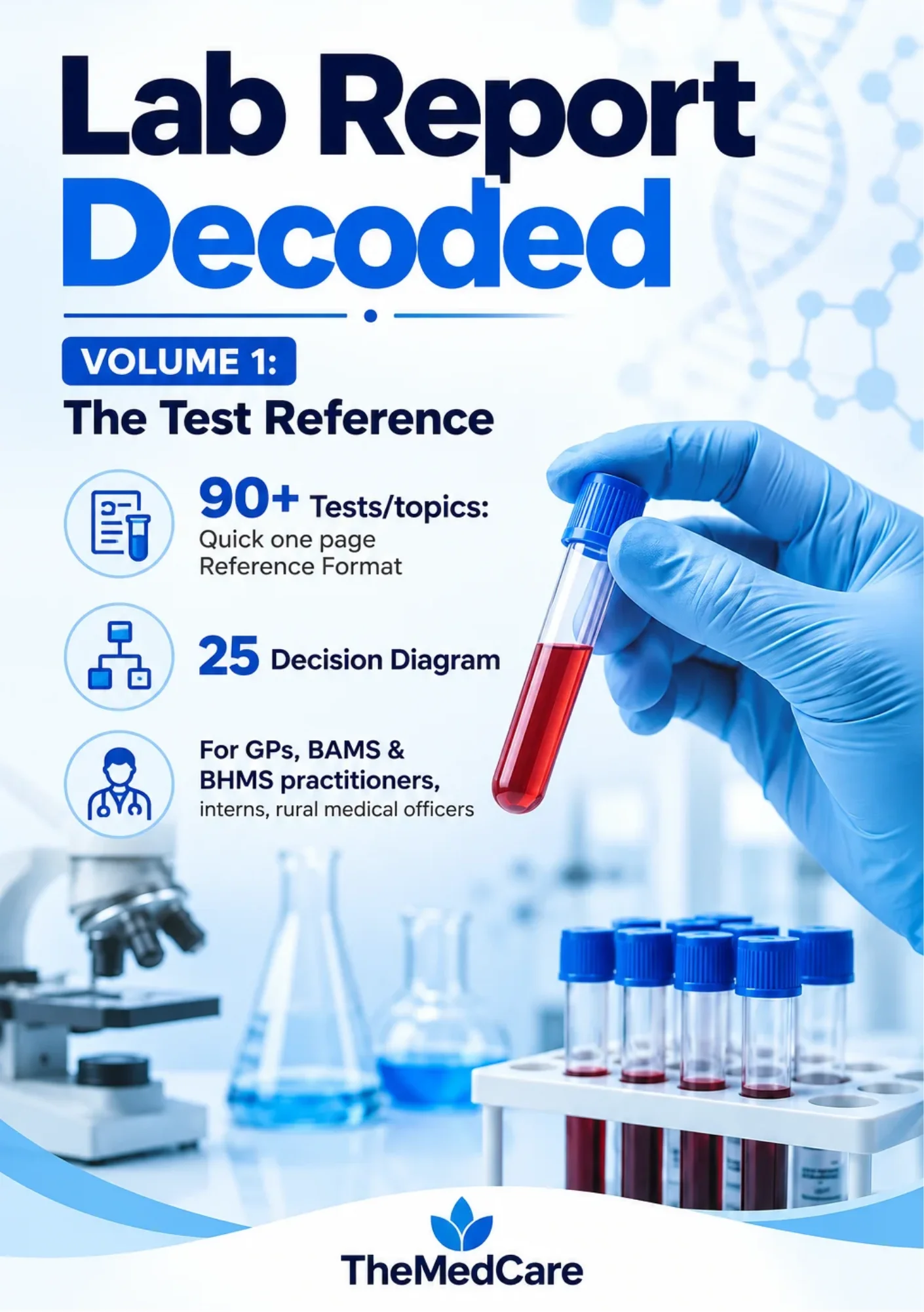
See the real pages for yourself
Flowcharts, decision ladders, mock reports and critical-value tables. Tap any page to zoom in.
30 values on the report. 3 minutes with the patient.
You've checked the range — but what now? Repeat, treat, or refer today? Textbooks give theory, protocols are too long. This set fills the gap in between.
| Test | Result | Unit | Range |
|---|---|---|---|
| Potassium (K⁺) | 6.4 H | mmol/L | 3.5–5.1 |
| Creatinine | 2.1 H | mg/dL | 0.7–1.3 |
| HbA1c | 8.4 H | % | <5.7 |
| Sodium (Na⁺) | 137 | mmol/L | 136–145 |
| Haemoglobin | 9.1 L | g/dL | 13–17 |
| TSH | 3.2 | µIU/mL | 0.4–4.5 |
Volume 1 is the dictionary.
Volume 2 is the decision manual.
Together they cover the whole journey — from reading the report to explaining it to your patient.
The Test Reference
- 90+ tests & topics — one test, one page. No flipping back and forth.
- Adult · Child · Pregnancy — reference range columns for all three
- ⚠ Critical values + what to do in the next 10 minutes
- 25 decision diagrams — anaemia by MCV, jaundice decoder, ABG 4-step
- Tube colours, fasting rules, 6 values that haemolysis falsifies
- Indian lab formats, ₹ test cost guide, drug–lab interference chart
Reading the Pattern
- 60+ complete cases — from report to action
- 30 mock Indian lab reports — abnormal values marked
- “What to do now” + “When to refer” — with number-based triggers
- ⚠ Trap box — the most common mistake in every pattern
- 60-second report scan method + the 10% rule for borderline values
- What to tell the patient — ready-to-use scripts
Every page follows one fixed layout
That's why you get the answer in 90 seconds in a busy OPD — your eyes know exactly where to look.
What the test measures — in one line
Which symptoms call for it
Tube colour, volume, fasting Y/N
Adult · child · pregnancy columns
Causes of a raised value + confirming clue
Causes of a low value + confirming clue
Only the drugs that change the number
Panic value + action for the next 10 minutes
What comes after the report — repeat, which test next, or refer. Every page ends in an action.
A realistic report — abnormal values marked
Age, sex, one-line complaint, one-line history
The 2–3 values to check first
The pattern, named in one line
3–4 differentials, each with a discriminating clue
Exactly which test — and why that one
Today's action + a number-based referral trigger
The most common mistake with this pattern
One case. What would you do?
This is how Volume 2 trains you — read the report, cover the answer, think it through, then check. That's how OPD speed is built.
The 60-second report scan
The order to read any report in — so no critical value ever slips past you.
K⁺ · Na⁺ · glucose · Hb · platelets · INR · troponin
Creatinine, electrolytes, sugar, Hb
The panel for the system the patient complains about
Compare with the last report — new or old?
Mildly abnormal — apply the book's rule
Still unclear after 60 seconds? Look at the patient, not the report.
For everyone who reads lab reports daily
Loved by doctors, nurses & interns
Both volumes. One price.
Get the hard copy and the soft copy is completely free — the book on your desk, the PDF on your phone.
📘 Soft Copy
- Complete soft copy of both volumes
- Read anywhere — phone, tablet, laptop
- Instant access after ordering
- Search and jump straight to any test
📦 Hard Copy
- Both volumes — printed, handy A5 size
- Always within reach on your OPD desk or duty room
- Critical-values poster page — snap a photo and pin it in your duty area
- Soft copy FREE (₹299 value)
Your questions, answered
What's the difference between Volume 1 and Volume 2?
Volume 1 is the “dictionary” — range, high/low causes, sample and critical value for every test. Volume 2 is the “decision manual” — 60+ cases that teach you to read the full report, recognise the pattern, choose the next test and know when to refer. They work best together.
Is it useful for BAMS / BHMS doctors?
Yes. The set is built for GPs, BAMS & BHMS practitioners, interns and rural medical officers — it teaches you to read modern lab reports step by step.
Are the cases from real patients?
No. All lab reports and cases are synthetic — names, labs and report numbers are invented. The values are kept medically plausible so you can practise on them.
Is this a treatment protocol or prescription guide?
No. It is an educational quick-reference and decision-support book. Reference ranges vary by lab, and dose/treatment decisions rest with the treating doctor.
Which guidelines does it follow?
It is aligned with current versions of ICMR, WHO, ADA, KDIGO, ATA, the Surviving Sepsis Campaign, IAP paediatric references, NABL/CLSI and Indian national programmes (NTEP, NACO, NVHCP, NCVBDC).
Do I get the soft copy with the hard copy?
Yes — every hard copy order includes the soft copy of both volumes absolutely FREE.
© 2026 TheMedCare · themedcare.in