The diagnosis doesn't choose the remedy. The case does.
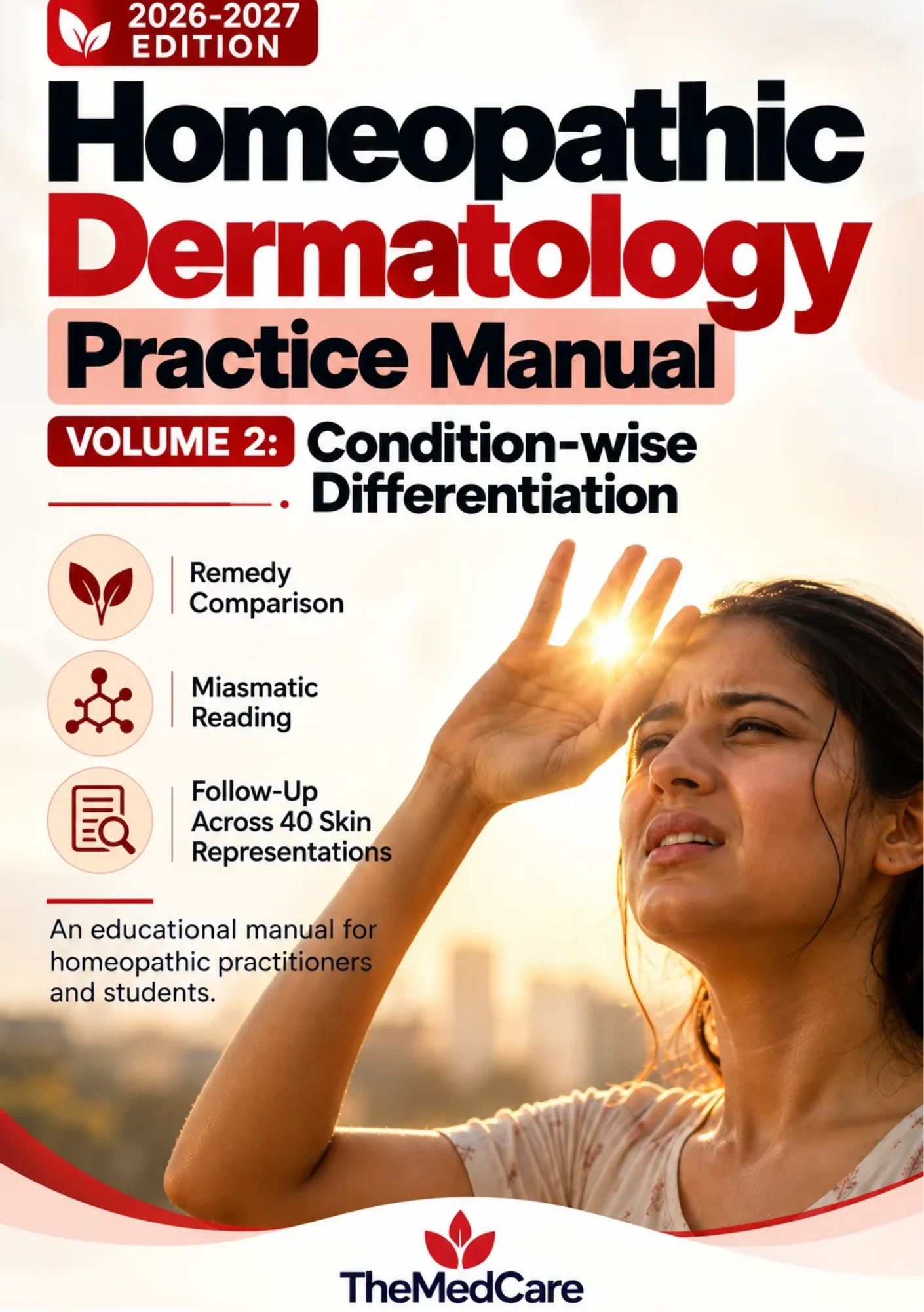
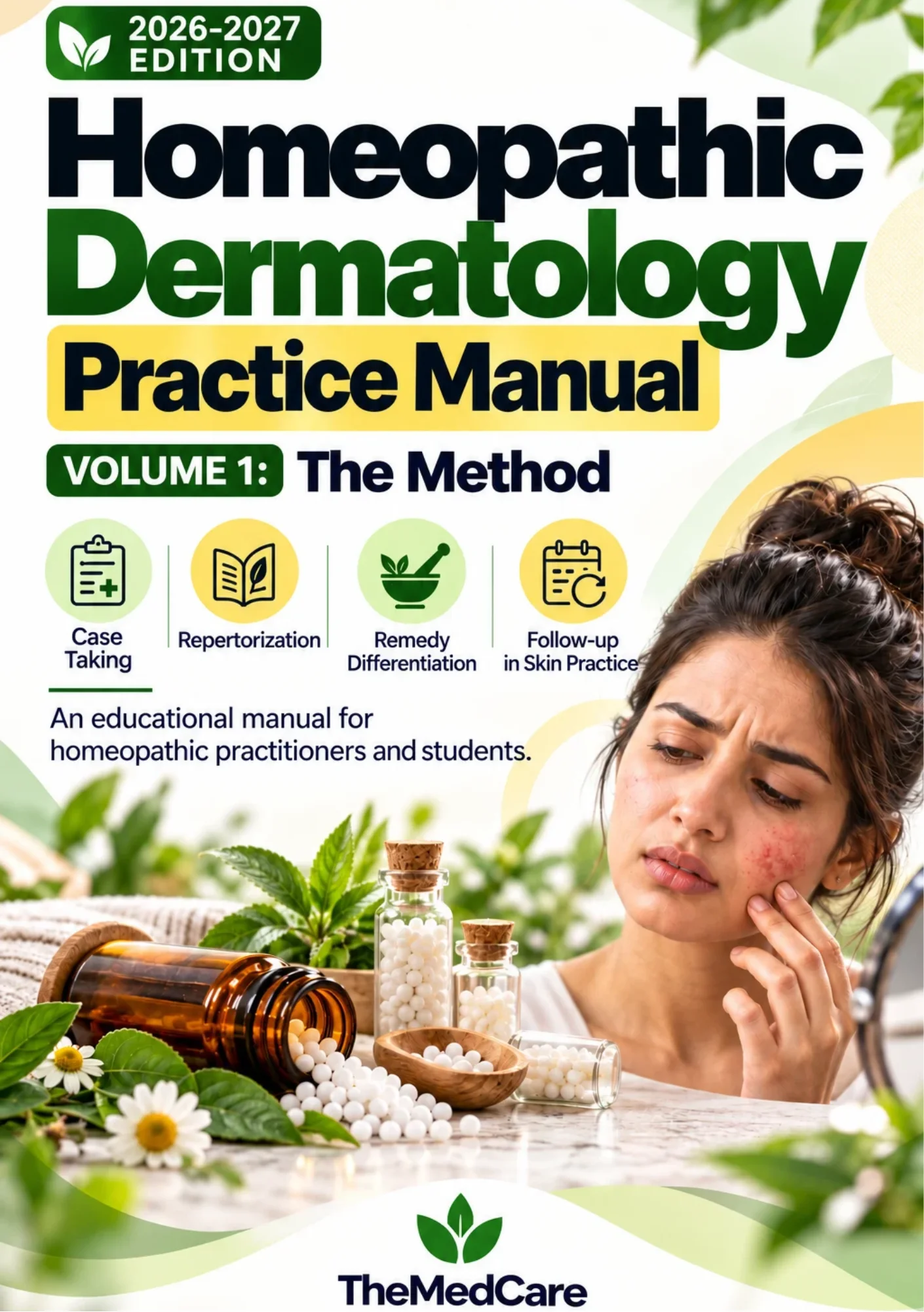
Homeopathic Dermatology Practice Manual is a 2-volume set for skin practice. Volume 1 teaches the method: case-taking, repertorisation, potency and follow-up. Volume 2 applies it to 40 skin presentations, with side-by-side remedy comparison tables and the one feature that separates each remedy.
Built on Hahnemann, Kent, Boericke, Clarke, Allen and Nash, with modern red flags from WHO, NLEP and IADVL.
Most skin prescriptions go wrong before the materia medica is opened.
Short OPD time, steroid creams from the chemist and a patient who only says "it itches". These are the moments this set was written for.
Eczema, both hands, itching.
That records the diagnosis, not the patient. There is nothing to individualise, so the remedy becomes a guess. Volume 1 gives you a case sheet built for short OPD time.
Vol 1 · Taking the skin case, p23–36Doctor, it burns and it itches.
Burning and itching fit several remedies at once. The next two questions, what makes it worse and what makes it better, usually do the separating.
Vol 2 · How to read a comparison table, p5I've already been using the chemist's cream.
A potent steroid blurs the modalities and the generals. Both volumes show how to read a steroid-modified case and when it needs medical co-management.
Vol 1 · Patients on steroids, p81Is this aggravation, or is the disease getting worse?
What to record at each visit, Kent's observations, and how to tell a remedy aggravation from disease progression.
Vol 1 · Follow-up, p71–80The skin is clearing, but the patient doesn't look well.
The book calls this its most important warning page: skin improving while the patient declines.
Vol 2 · Follow-up across conditions, p99Do I manage this, or refer?
Ten skin presentations that must not be managed alone, each marked now, today or this week.
Vol 1 · Red flags and scope, p89–94Four axes separate remedies. Turn the cube.
Every comparison table in Volume 2 sorts remedies along the same four axes. In skin cases the modality usually decides first, because patients report it on their own and it changes least between visits.
Sensation
What the patient feels in the skin
burning · itching · stinging · rawness · crawlingModality
What makes it worse and better
heat · cold · washing · night · bed · open air · dampConcomitant
What runs alongside, unasked
appetite · sleep · mood · menses · stool · thirstGeneral
How the whole patient behaves
thermal state · perspiration · build · reaction to illnessTwo patients, same diagnosis
The worked example from Volume 2, page 6. Both have chronic eczema of the hands.
| Axis | Patient A | Patient B |
|---|---|---|
| Complaint | Dry, cracked palms for two winters | Dry, cracked palms for two winters |
| Sensation | Burning in the fissures | Burning in the fissures |
| Worse | Washing; cold air; winter | Warmth of the bed; at night; wool |
| Better | Warm covering; dry weather | Cool air; uncovering the hands |
| Concomitant | Chilly; cracks bleed; skin thickened | Unrefreshing sleep; hungry late morning |
| General | Marked chilliness; worse every winter | Warm-blooded; kicks off the covers |
| Decided by | Modality + thermal general | Modality + thermal general |
The sensation is identical. The thermal reaction is opposite, and that is what separates the two remedies.
Method first, application later.
Read the classical frame
Suppression, Hering's direction of improvement, miasms, local versus constitutional prescribing.
Describe before you name
Lesion description in words that can be matched to rubric language, with colour on Indian skin.
Take and analyse the case
From the patient's words to rubrics to a short list of remedies to compare, with three worked cases.
Follow up and stay in scope
Posology, the second prescription, special situations and the red flags that end at referral.
Case-taking, repertorisation, remedy differentiation and follow-up
How to think about any skin case. Disease-wise remedy lists are kept out of this volume on purpose, so the method stays clean.
- Part 1p5–14
Skin in homeopathic thinking
Expression, local vs constitutional, suppression, Hering's direction, miasms, acute vs chronic, scope.
- Part 2p15–22
Essential recognition
Lesions, colour on Indian skin, distribution, discharges, crusts, bedside tests, nails, eight-point description.
- Part 3p23–36
Taking the skin case
Ten building blocks, sensation, modalities, concomitants, causation, generals, drug history and a case sheet.
- Part 4p37–50
Repertorisation
Common errors, weighting, Kent's organisation, rubric language, grids and three worked cases.
- Part 5p51–62
Remedy differentiation
Keynotes vs totality, the four axes, comparison grids, nosodes and smaller remedies.
- Part 6p63–70
Posology
Potency, LM and centesimal scales, repetition, aggravation, external applications, auxiliary measures.
- Part 7p71–80
Follow-up
What to record, Kent's observations, aggravation vs progression, when to change, the non-responder audit.
- Part 8p81–88
Special situations
Patients on steroids, children, pregnancy, the elderly, diabetic and immunocompromised patients, co-management.
- Part 9p89–94
Red flags and scope
Ten emergencies, SJS/TEN, erythroderma, pemphigus, cellulitis, leprosy, pigmented lesions, refer today vs this week.
Remedy comparison, miasmatic reading and follow-up across 40 skin presentations
Each condition follows the same layout: clinical picture, three case-taking questions, a seven-column remedy table, miasmatic reading, auxiliary measures, follow-up, and when to refer.
- Part 1p5
How to use comparison tables
The four axes on one page, and a worked example of two patients with the same diagnosis.
- Part 2p9
Eczematous conditions · 7
Atopic, hand, contact, seborrhoeic, nummular and stasis eczema, lichen simplex chronicus.
- Part 3p22
Papulosquamous · 5
Psoriasis, lichen planus, pityriasis rosea, pityriasis alba and more.
- Part 4p33
Fungal and parasitic · 5
Dermatophytosis, steroid-modified tinea, tinea capitis, candidal intertrigo, scabies.
- Part 5p45
Bacterial and viral · 5
Impetigo, folliculitis and furuncle, herpes simplex, herpes zoster, molluscum.
- Part 6p57
Pigmentary and hair · 8
Melasma, post-inflammatory pigmentation, vitiligo, acanthosis nigricans, alopecia areata, androgenetic alopecia, telogen effluvium.
- Part 7p72
Acne, urticaria and nails · 6
Acne, acne in adult women, rosacea, urticaria and angioedema, onychomycosis, paronychia.
- Part 8p84
Paediatric and special groups · 4
Napkin dermatitis, infant scalp, miliaria, skin in pregnancy, diabetic skin, patients on steroids.
- Part 9p94
Red flags: no remedy, refer
Serious conditions end at referral, not with a remedy.
- Part 10p99
Follow-up across conditions
Review intervals, direction of change, the non-responder audit and a printable follow-up sheet.
Classical teaching, stated plainly.
Sources named on the page
Symptom pictures come from classical literature (Hahnemann, Kent, Boericke, Clarke, Allen, Hering, Nash) and are marked as paraphrased summaries where they are not direct quotes.
An honest note on course
Each condition says where response is commonly slow, partial or variable. The books do not claim that any remedy cures any disease.
Serious cases end at referral
Emergencies get no remedy. They get a referral line, a checklist of what to record, and the page to turn to.
Ten presentations you must not manage alone.
In every case: examine, record vitals and drug history, refer, and inform the patient clearly.
Real pages from both volumes.
Spin the ring or tap any page to read it full size.
Drag to spin · tap a page to open it
What practitioners and students say
Feedback on both volumes from homeopathic practitioners, students and readers.
reviews
Case-taking Made More Structured
“Volume 1 ka case-taking aur follow-up structure kaafi organised hai. Sensation, modalities aur patient ki general symptoms ko systematically record karne ka framework useful laga. Dono volumes ko saath padhne se topics ko samajhna easier hota hai.”

Helpful for Revision
“Comparison tables aur clear headings ki wajah se revision karna convenient hai. Volume 1 method samjhata hai, jabki Volume 2 condition-wise differences ko organise karta hai. Students ke liye ek useful reference format hai.”

Useful Condition-Wise Organisation
“Eczema, acne, pigmentation aur doosri skin presentations ko alag sections mein organise kiya gaya hai. Remedy comparison ke saath deciding features aur follow-up points diye gaye hain, jo study aur reference ke liye helpful hain.”

More Than Just Remedy Lists
“Mujhe iska structured approach pasand aaya. Books mein sirf remedy names nahi, balki case details, modalities, comparison aur follow-up ko bhi importance di gayi hai. Red flags aur referral guidance ka inclusion bhi notable hai.”

A Well-Organised Two-Volume Reference
“Dono volumes ka purpose clear hai—pehli book methodology par focus karti hai aur doosri different skin conditions ki comparison par. Tables, case examples aur topic-wise arrangement ki wajah se relevant section dobara dekhna easy hai.”

Two volumes for the consulting-room shelf.
Volume 1 · 96 pages
The full method, from case-taking to the second prescription.
Volume 2 · 108 pages
40 skin presentations with seven-column remedy tables.
Three worked repertorisation cases
Chronic eczema, urticaria and psoriasis with a suppression history.
Printable sheets
Skin case sheet, follow-up sheet and a condition follow-up record.
Symptom-to-remedy index
Leads you to a group of remedies to compare, never to a single answer.
Red-flag summary cards
Photocopy and keep in the consulting room.
Soft copy
- Both volumes, 204 pages
- Instant access after payment
- Read on phone, tablet or laptop
- Full-colour tables and clinical photos
- Printed books
Hard copy + free soft copy
- Both printed volumes, A5, full colour
- Soft copy free, so you can start today
- Free delivery across India
- Photocopy the case and follow-up sheets
- Mark rubrics and remedies in the margins
Secure checkout · UPI, cards and net banking
Is this set for you?
Yes, if you are
- A BHMS student or intern who wants skin cases to make sense
- A registered homeopathic practitioner who sees skin patients every week
- Preparing for MD (Hom) or revising repertorisation
- Someone who wants case sheets and follow-up records you can actually use in OPD
Not for you if
- You are a patient looking to treat your own skin. These are practitioner manuals; please see a qualified doctor.
- You want a one-remedy-per-disease list. The whole book is built against that habit.
- You want to manage emergencies with remedies. The books send those to referral.
Questions
Who is this set written for?
BHMS students and interns, and registered homeopathic practitioners who see skin cases. It assumes Indian OPD conditions: short consultation time, brown skin, and patients who have often used a chemist's steroid cream first.
How are the two volumes different?
Volume 1 is the method: case-taking, lesion description, repertorisation, remedy differentiation, posology, follow-up, special situations and red flags. Volume 2 applies that method condition by condition across 40 skin presentations, with comparison tables, miasmatic reading, auxiliary measures and referral points.
Which repertory does it follow?
Rubric wording follows Kent's Repertory (1897), and the book asks you to confirm it in your own edition. Materia medica pictures are drawn from Hahnemann, Kent, Boericke, Clarke, Allen, Hering and Nash, with the source shown in the tables.
Does the book claim remedies cure skin diseases?
No. It presents classical homeopathic teaching as it appears in the literature, for education, and states where response is commonly slow, partial or variable. Serious and emergency conditions end at referral. Prescribing stays with a registered practitioner within their scope of practice.
Are there clinical photos?
Yes. Volume 2 opens most conditions with a clinical photograph, and both volumes use original diagrams and colour-coded tables. You can see real pages in the Look inside section above.
How do I receive the soft copy?
You get access right after payment and can read it on your phone, tablet or laptop. With the hard copy, the soft copy comes free so you can start before the printed books arrive.
How is the hard copy delivered?
The printed set is shipped to your address anywhere in India, with tracking details sent after dispatch.
Your next eczema case deserves more than a remedy list.
Both volumes, 204 pages, 40 skin presentations. Read the soft copy tonight and keep the printed set on your desk.