Perform it right.
Run it right.
Exact ml, grams, minutes and °C for every Panchakarma step — plus the complete system to set up, staff, schedule and document your Panchakarma unit. Two manuals. One complete set.
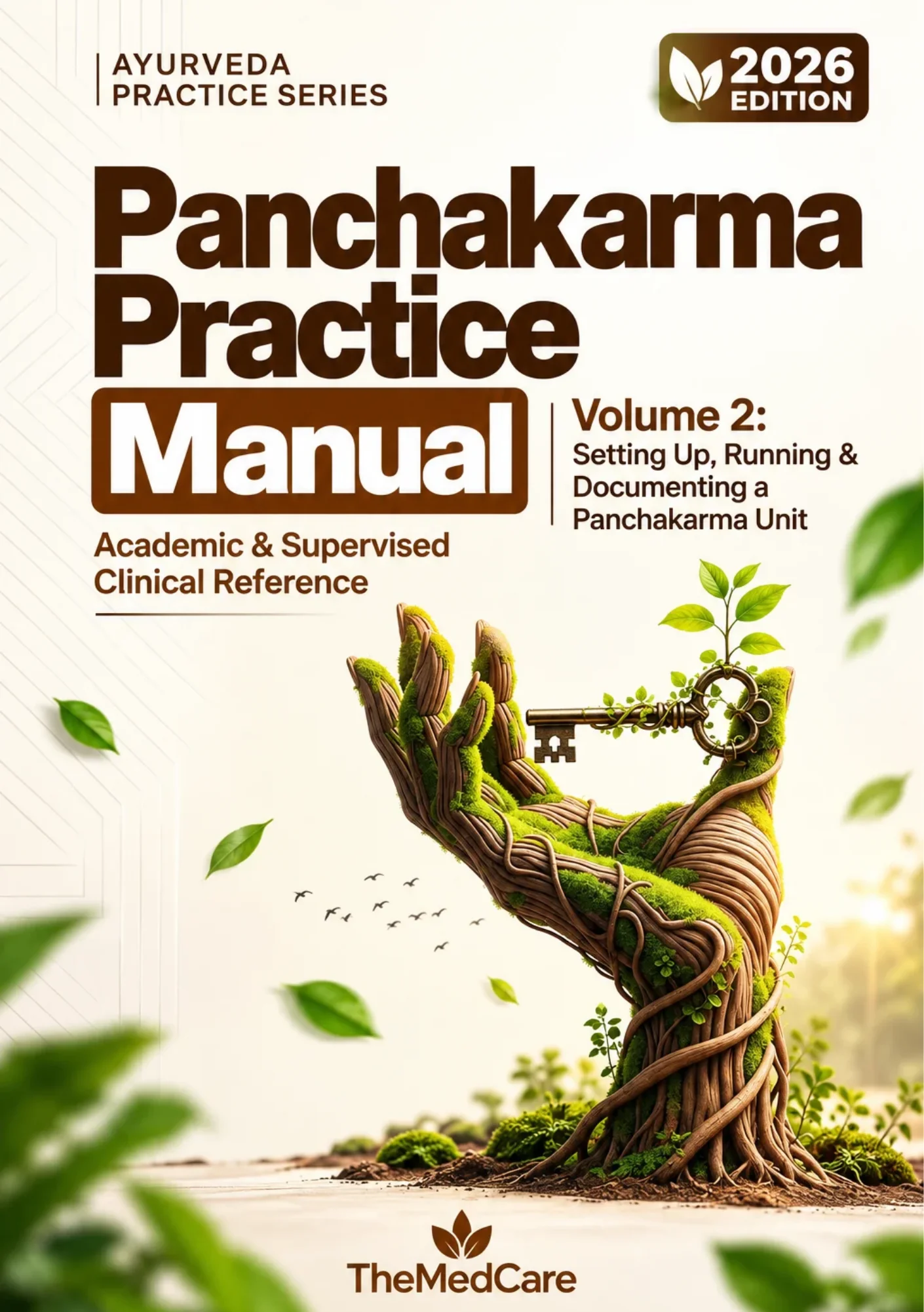
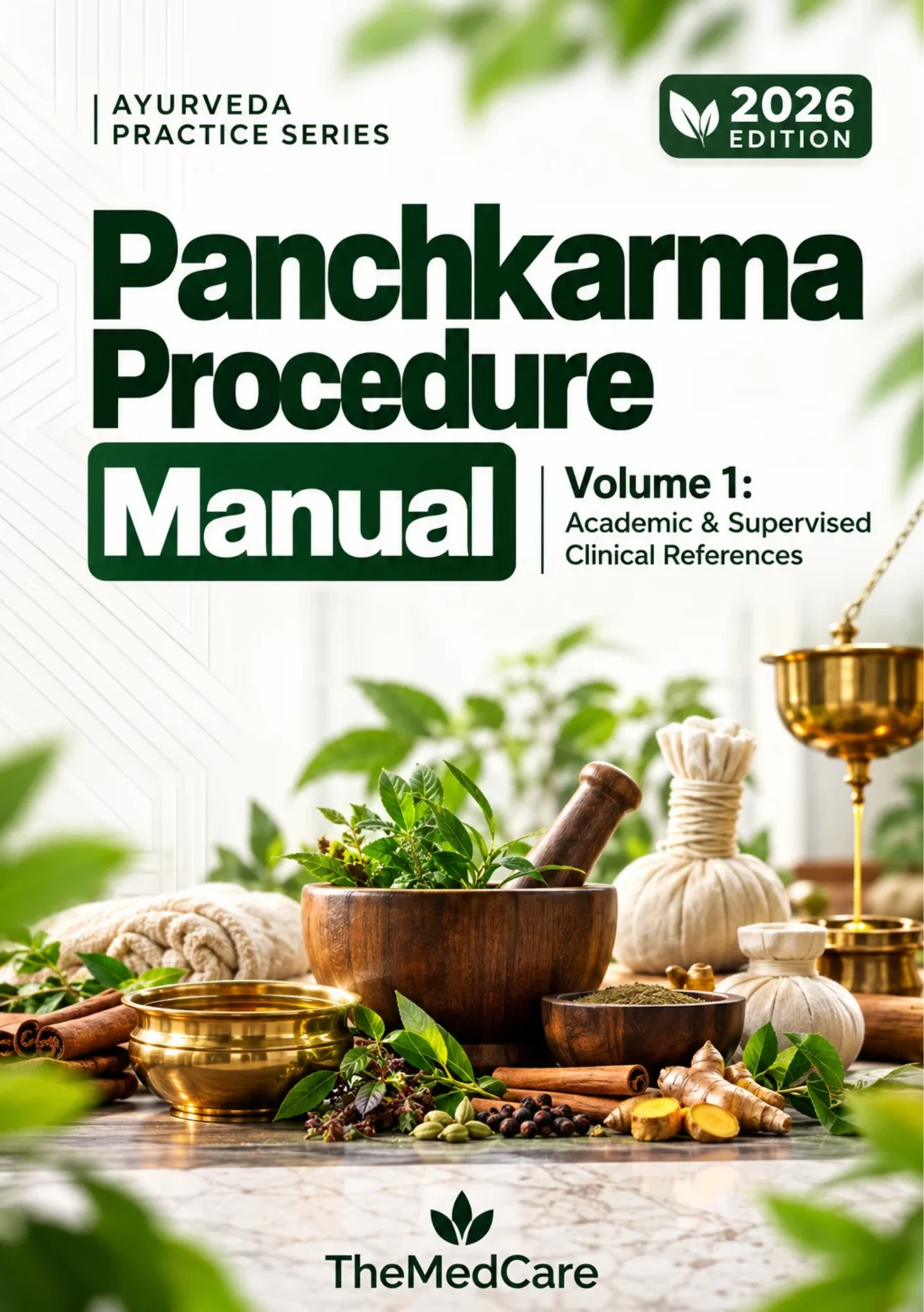
See the real pages for yourself
Day maps, dose tables, Basti schedules, room layouts and ready-to-use forms. Tap any page to zoom in.
Textbooks tell you what. Nobody tells you how much.
Classical texts give the principle. Hospital practice gives the habit. What's missing in between is the exact number, the exact time — and a system to run it every single day.
| Time | Karma | Table | Status |
|---|---|---|---|
| 07:00 | Abhyanga | T1 | Done |
| 07:45 | Swedana | T1 | Done |
| 08:30 | Anuvasana Basti | T2 | In progress |
| 09:15 | Nasya | T3 | Scheduled |
| 10:00 | Virechana review | Dr. | Scheduled |
| 11:30 | Response record | Form 05 | Pending |
Volume 1 teaches you to do it.
Volume 2 teaches you to run it.
Technique on the left, organisation on the right — together they take you from the first procedure to a fully running Panchakarma service.
Panchakarma Procedure Manual
- A number on every line — ml, grams, minutes, drops, °C. No guesswork.
- Time-stamped protocols — 06:30, 45 min, Day 4 — on a 24-hour clock
- Samyak Yoga · Ayoga · Atiyoga — three end-point boxes closing every karma
- 32 procedure charts + a one-page ⚠ emergency card
- Day maps, hour-by-hour protocols, dose tables and vyapad (complications)
- Classical references (Charaka, Sushruta, Ashtanga Hridaya, Sharangadhara) clearly separated from hospital-practice examples
Panchakarma Practice Manual
- 3 unit blueprints — 1 table, 3 tables, hospital — area, staff, patients/day
- Room layout & dimensions — droni, drainage, electrical points, waste
- Staff roles, competency checklist, SOP library & supervision
- Course design — 7 / 14 / 21-day structures + table scheduling
- 8-stage patient journey and 10 printable forms — consent to follow-up
- 15 condition protocols, adverse-event reporting, referral triggers & quality audit
Learn one chapter, and you can read them all
Every karma in Volume 1 and every part of Volume 2 follows the same fixed structure — so you always know where to look.
The whole course on one page — what happens on which day
Clock times, not “after some time”
Exact quantities in ml, grams and drops
What to observe and record during the karma
Correct end-point, too little, too much — and what to do
Complications and the immediate response
Every value is tagged so you always know whether it comes from a classical text or is a hospital-practice example to adapt to your institute.
Every part opens with exactly what you will be able to organise
Square feet, litres, minutes, ₹ ranges, staff count, days
Each one comes with a clear action line
Every part closes with a quick self-test
One manual, three reading orders — start where your situation starts.
Planning a Panchakarma room?
Most clinics get the room wrong before the first patient walks in. Volume 2 gives you the dimensions, the layout and the paperwork before you spend a rupee.
Three unit blueprints. Pick yours.
Every chapter of Volume 2 is planned for three sizes of unit — so the advice always fits the space and team you actually have.
Panchakarma alongside your main OPD
- Area250–350 sq ft
- Therapists1–2
- PhysicianPart-time
- Patients/day3–5
Panchakarma as a service of its own
- Area700–900 sq ft
- Therapists4–6
- PhysicianFull-time
- Patients/day9–15
A full Panchakarma department
- Area2000+ sq ft
- Therapists10–20
- Physician2+ shifts
- Patients/day24–48
Indicative planning ranges from Volume 2 — adapt to your own setting.
Made for the people who run Panchakarma
Trusted by practitioners & students
Both manuals. One price.
Get the hard copy and the soft copy is completely free — the manual in your unit, the PDF on your phone.
📘 Soft Copy
- Complete soft copy of both manuals
- Read anywhere — phone, tablet, laptop
- Instant access after ordering
- Print the forms you need for your unit
📦 Hard Copy
- Both manuals — printed, handy A5 size
- Keep it right in the therapy room
- Emergency card + 10 forms ready to photocopy
- Soft copy FREE (₹299 value)
Your questions, answered
What's the difference between Volume 1 and Volume 2?
Volume 1 (Procedure Manual) is about doing — the exact steps, quantities, timings and end-points of every karma from Purva Karma to Samsarjana Krama. Volume 2 (Practice Manual) is about running — the room, staff, SOPs, course design, patient journey, printable forms, condition protocols and quality & safety. They work best together.
Who are these manuals for?
Qualified Ayurvedic physicians and appropriately supervised trainees — BAMS doctors, MD Panchakarma scholars, unit in-charges and clinic owners. They are not patient self-care or home-procedure guides.
Do they cover patient selection and contraindications?
No. Volume 1 starts after the patient has been assessed and selected. Patient selection, indications, contraindications and consent decisions stay with the treating physician and your institution's SOP.
Which classical sources are used?
Charaka Samhita, Sushruta Samhita, Ashtanga Hridaya and Sharangadhara Samhita. Values that come from hospital practice rather than a classical text are clearly marked “HP” so you can replace them with your institute's own values.
Can Volume 2 help me set up a new Panchakarma unit?
Yes — it covers layout, equipment, staffing, scheduling, documentation and a first-90-days plan, with indicative ranges for three unit sizes. Regulatory requirements vary by state, so verify current rules with NCISM and your State Board before acting.
Do I get the soft copy with the hard copy?
Yes — every hard copy order includes the soft copy of both manuals absolutely FREE.
© 2026 TheMedCare · themedcare.in